andrewducker: (Teddy of Borg)
andrewducker ([personal profile] andrewducker) wrote2025-12-13 08:46 pm
Entry tags:

Life with two children: Renting realms

About a month ago Gideon watched a bunch of videos about Minecraft, asked if he could play it on her tablet, got a few pointers from me to get him going and then dove in and started building stuff. At an impressive rate considering that he can't read any word more than 4 letters long.

Yesterday I mentioned Minecraft to Sophia, and she showed interest, so I set her up on my desktop and she got stuck in. She's asked for more help than Gideon has, but has been happily building herself an underground house. And just now I wanderd into my office to see her on the desktop and Gideon sitting on the floor with his tablet, with the two of them intermittently showing each other cool things that they'd found.

So tonight, after they're asleep, I'm going to set them both up for online play, and rent a realm*, so that they can be in the same world with each other.


*I am totally willing to pay £3.99 per month to not have to maintain my own server.
rachelmanija: (Books: old)
rachelmanija ([personal profile] rachelmanija) wrote2025-12-12 01:45 pm

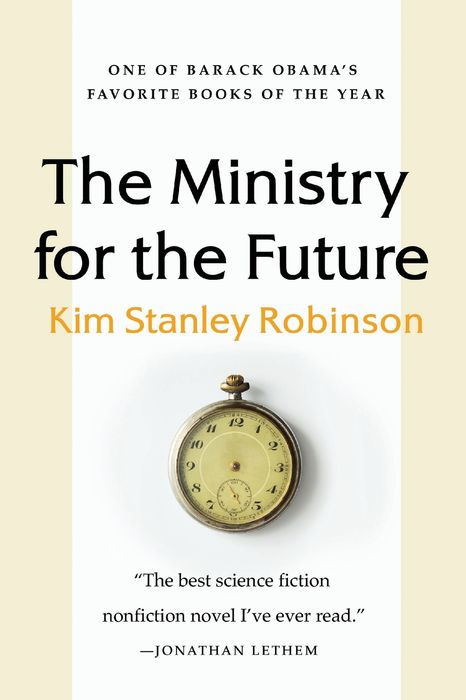
The Ministry for the Future, by Kim Stanley Robinson


After a wet-bulb heat wave kills thousands in India, the UN forms an organization, the Ministry for the Future, intended to deal with climate change on behalf of future generations. They're not the only organization trying mitigate or fight or adapt to climate change; many other people and groups are working on the same thing, using everything from science to financial incentives to persuasion to terrorism.

We very loosely follow two very lightly sketched-in characters, an Irish woman who leads the Ministry for the Future and an American man whose life is derailed when he's a city's sole survivor of the Indian wet-bulb event, but the book has a very broad canvas and they're not protagonists in the usual sense of the word. The book isn't about individuals, it's about a pair of phenomena: climate change and what people do about it. The mission to save the future is the protagonist insofar as there is one.

This is the first KSR book I've actually managed to finish! (It's also the only one that I got farther in than about two chapters.) It's a very interesting, enlightening, educational book. I enjoyed reading it.

He's a very particular kind of writer, much more interested in ideas and a very broad scope than in characters or plot. That approach works very well for this book. The first chapter, which details the wet-bulb event, is a stunning, horrifying piece of writing. It's also the closest the book ever comes to feeling like a normal kind of novel. The rest of it is more like a work of popular nonfiction from an alternate timeline, full of science and economics and politics and projects.

I'm pretty sure Robinson researched the absolute cutting edge of every possible action that could possibly mitigate climate change, and wrote the book based on the idea of "What if we tried all of it?"

Very plausibly, not everything works. (In a bit of dark humor, an attempt to explain to billionaires why they should care about other people fails miserably.) Lots of people are either apathetic or actively fighting against the efforts, and there's a whole lot of death, disaster, and irreparable damage along the way. But the project as a whole succeeds, not because of any one action taken by any one group, but because of all of the actions taken by multiple groups. It's a blueprint for what we could be doing, if we were willing to do it.

The Ministry for the Future came out in 2020. Reading it now, its optimism about the idea that people would be willing to pull together for the sake of future generations makes it feel like a relic from an impossibly long time ago.
siderea: (Default)
Siderea ([personal profile] siderea) wrote2025-12-12 06:49 am
Entry tags:

Update [me, health, Patreon]

So, I, uh, got my RSI/ergonomics debugged!* I then promptly lost two days to bad sleep due to another new mechanical failure of the balky meat mecha and also a medical appointment in re two previous malfunctions. But I seem back in business now. The new keyboard is great.

Patrons, I've got three Siderea Posts out so far this month and it's only the 12th. I have two more Posts I am hoping to get out in the next three days. Also about health insurance. We'll see if it actually happens, but it's not impossible. I have written a lot of words. (I really like my new keyboard.)

Anyways, if you weren't planning on sponsoring five posts (or – who knows? – even more) this month, adjust your pledge limits accordingly.

* It was my bra strap. It was doing something funky to how my shoulder blade moved or something. It is both surprising to me that so little pressure made so much ergonomic difference, and not surprising because previously an even lighter pressure on my kneecap from wearing long underwear made my knee malfunction spectacularly. Apparently this is how my body mechanics just are.
siderea: (Default)
Siderea ([personal profile] siderea) wrote2025-12-12 06:17 am
Entry tags:

Choosing Health Insurance: HSAs: FYI re bronze, catastrophic plans [healthcare, US, Patreon]

Canonical link: https://siderea.dreamwidth.org/1890494.html


0.

Hey Americans (and other people stuck in the American healthcare system)! Shopping for a health plan on your state marketplace? Boy, do I have some information for you that you should have and probably don't. There's been an important legal change affecting your choices that has gotten almost no press.

Effective with plan year 2026 all bronze level and catastrophic plans are statutorily now HDHPs and thus HSA compatible. You may get and self-fund an HSA if you have any bronze or catastrophic plan, as well as any plan of any level designated a HDHP.

2025 Dec 9: IRS.gov: "Treasury, IRS provide guidance on new tax benefits for health savings account participants under the One, Big, Beautiful Bill"
Bronze and Catastrophic Plans Treated as HDHPs: As of Jan. 1, 2026, bronze and catastrophic plans available through an Exchange are considered HSA-compatible, regardless of whether the plans satisfy the general definition of an HDHP. This expands the ability of people enrolled in these plans to contribute to HSAs, which they generally have not been able to do in the past. Notice 2026-05 clarifies that bronze and catastrophic plans do not have to be purchased through an Exchange to qualify for the new relief.

If you are shopping plans right now (or thought you were done), you should probably be aware of this. Especially if you are planning on getting a bronze plan, a catastrophic plan, or any plan with the acronym "HSA" in the name or otherwise designated "HSA compatible".

The Trump administration doing this is tacit admission that all bronze plans have become such bad deals that they're the economic equivalent of what used to be considered a HDHP back when that concept was invented, and so should come with legal permission to protect yourself from them with an HSA.

Effective immediately, you should consider a bronze plan half an insurance plan.

Read more [3,340 words] )

This post brought to you by the 221 readers who funded my writing it – thank you all so much! You can see who they are at my Patreon page. If you're not one of them, and would be willing to chip in so I can write more things like this, please do so there.

Please leave comments on the Comment Catcher comment, instead of the main body of the post – unless you are commenting to get a copy of the post sent to you in email through the notification system, then go ahead and comment on it directly. Thanks!
kaberett: Trans symbol with Swiss Army knife tools at other positions around the central circle. (Default)
kaberett ([personal profile] kaberett) wrote2025-12-12 11:04 am
Entry tags:

more on visual culture in science

This morning I am watching the lecture I linked to on Tuesday!

At 6:53:

Here is an example of how the Hubble telescope image of the Omega nebula, or Messier 17, was created, by adding colours -- which seem to have been chosen quite arbitrarily -- and adjusting composition.

The slide is figure 13 (on page 10) from an Introduction to Image Processing (PDF) on the ESA Hubble website; I'm baffled at the idea that the colours were chosen "arbitrarily" given that the same PDF contains (starting on page 8) §1.4 Assigning colours to different filter exposures. It's not a super clear explanation -- I think the WonderDome explainer is distinctly more readable -- but the explanation does exist and is there.

Obviously I immediately had to stop and look all of this up.

(Rest of the talk was interesting! But that point in particular about modern illustration as I say made me go HOLD ON A SEC--)

kaberett: Trans symbol with Swiss Army knife tools at other positions around the central circle. (Default)
kaberett ([personal profile] kaberett) wrote2025-12-11 10:28 pm
Entry tags:

[surgery] one year on!

I continue extremely grateful to no longer have ureteric stents.

a bit of stock-taking )

andrewducker: (Unless I'm wrong)
andrewducker ([personal profile] andrewducker) wrote2025-12-11 07:12 pm

Timeline of a new phase in my life.

About two months ago, I had a nasty respiratory infection. And while I was lying awake one night, I could hear my heart beating quite loudly.

Having had multiple friends go to the doctor to check on something and then have the doctor tell them that they urgently needed medication before their high blood pressure did them serious damage/killed them, I thought I should pop in to the doctor for a chat.

They checked me on the spot, said my blood pressure was a little high, but nothing terrible, and told me to join the queue to borrow a blood pressure device. [personal profile] danieldwilliam gave me his old one, and I spent a couple of weeks taking results. Which mostly showed that my pressure is fine in the morning, but that after I've spent 90 minutes shouting at Gideon to stop bloody well mucking about and go to sleep, it's a fair chunk higher than it should be. They also sent me for an ECG (which showed I have Right Bundle Branch Block, a harmless and untreatable condition that affects 15% of the population), an eye test (which found nothing), and a fasting blood test (which showed I'm still not diabetic, even though I can't have sugar in my diet even slightly any more).

They then had a phone call with me to chat it through, said that I'm a little high (on average), and a little young for it to be a major worry, but if I was up for it they could put me on some pills for hypertension.. I agreed that it sounded sensible, and the doctor sounded positively relieved that she hadn't had to bully me into it.

The weird feeling is that this is the first time I've been put on to a medicine that I will have to take for the rest of my life. There is now "The time I didn't have to take medicine every day" and "The time where I had to take medicine every day". Which definitely feels like an inflection point in my life. (Endless sympathy, of course, for people I know who have to take much worse things than a tiny tasteless pill with very few side-effects.)

So all-in-all, nothing major. Just the next step. I'm just very glad for the existence of modern medicine.
wildeabandon: picture of me (Default)
Sebastian ([personal profile] wildeabandon) wrote2025-12-11 12:18 pm

Socialising and French (attempt number 343 to start posting regularly again...)

...but I have (sort of) a plan this time. I've put a weekly reminder in my diary to post, which I hope will help, and I'm going to create a sort of vague template of 'things to update about' which I can follow if I'm feeling uninspired, but not restrain myself to if there's something in particular that takes my fancy.

I had a resolution this semester that I was going to study less and socialise more, which is perhaps not an entirely typical student resolution, but felt like it would be appropriate for me. I largely failed. This is partly because there were a number of occasions where I made a plan to go to an event, and then when the time came around I was faced with a choice of going outside and travelling to somewhere with lots of background noise where I would have to interact with unfamiliar humans, or staying in the quiet warm library with my books and my translation (or other work), and somehow the latter was always much more appealing.

So on the one hand, it doesn't actually feel particularly unhealthy that I'm studying instead of socialising because that's what I want to do rather than because I feel it's what I should do, but on the other hand, if I want to reach the stage where I have a francophone circle of not-unfamiliar people to spend time with here, I'm going to have to go through the 'socialising with unfamiliar people' bit first.

On a related note, I am feeling a bit frustrated with my (lack of) language acquisition here. Before I moved out lots of people suggested that being here and using French on a daily basis would lead to a big improvement, but it doesn't seem to have happened. Partly that's probably because I'm /not/ really using French on a day to day basis. I mean, I use it in the shops and to read the news and listen to announcements on the railways, but my actual day to day work is in English, and although I can read fairly fluently, follow to audiobooks and some podcasts, and have an interesting conversation 1-1 with plenty of context cues, no background noise and an interlocutor who is speaking clearly, I still struggle in fairly basic situations without those accommodations. And crucially, I don't think I've improved significantly since moving here, so I need to do something more active to improve, so I've found a "table de langues" to try next Wednesday evening, and if I just don't go to the library after my final lecture that day, it should be easier to escape it's gravity.
kaberett: Trans symbol with Swiss Army knife tools at other positions around the central circle. (Default)
kaberett ([personal profile] kaberett) wrote2025-12-10 11:08 pm

side-tracks off side-tracks

One of the things I found yesterday, while getting distracted from transcription by regretting not having taken History and Philosophy of Science (or, more accurately, not having shown up to the lectures to just listen), was some tantalising notes on the existence of a four-lecture series entitled Visual Culture in Science and Medicine:

Science today is supremely visual – in its experiments, observations and communication, images have become integral to the scientific enterprise. These four lectures examine the role of images in anatomy, natural history and astronomy between the 15th and the 18th centuries. Rather than assessing images against a yardstick of increasing empiricism or an onward march towards accurate observation, these lectures draw attention to the myriad, ingenious ways in which images were deployed to create scientific objects, aid scientific arguments and simulate instrumental observations. Naturalistic styles of depictions are often mistaken for evidence of first-hand observation, but in this period, they were deployed as a visual rhetoric of persuasion rather than proof of an observed object. By examining the production and uses of imagery in this period, these lectures will offer ways to understand more generally what was entailed in scientific visualisation in early modern Europe.

I've managed to track down a one-hour video (that I've obviously not consumed yet, because audiovisual processing augh). Infuriatingly Kusukawa's book on the topic only covers the sixteenth century, not the full timespan of the lectures, and also it's fifty quid for the PDF. I have located a sample of the thing, consisting of the front matter and the first fifteen pages of the introduction (it cuts off IN MID SENTENCE).

Now daydreaming idly about comparative study of this + Tufte, which I also haven't got around to reading...

rachelmanija: (Books: old)
rachelmanija ([personal profile] rachelmanija) wrote2025-12-10 10:07 am

The Night Guest, by Hildur Knútsdóttir


An Icelandic horror novella translated by Mary Robinette Kowal! I had no idea she's fluent in Icelandic.

Iðunn experiences unexplained fatigue and injuries when she wakes up, but is gaslit by doctors and offered idiotic remedies by co-workers. (Very relatable!) Meanwhile, she's being semi-stalked by her ex-boyfriend/co-worker, her parents refuse to accept that she's a vegetarian and keep serving her chicken, and the only living beings she actually likes are the neighborhood cats that she's allergic to.

After what feels like an extremely long time, it finally occurs to her that she might be sleepwalking, and some time after that, it finally occurs to her to video herself as she sleeps. At that point some genuinely scary/creepy/unsettling things happen, and I was very gripped by the story and its central mystery.

Is Iðunn going out at night and committing all the acts she's normally too beaten down or scared to do while sleepwalking or dissociating? Is she having a psychotic break? Is she a vampire? Is she possessed? Does it have something to do with a traumatic past event that's revealed about a third of the way in?

Other than the last question, I have no idea! The ending was so confusing that I have no idea what it was meant to convey, and it did not provide any answers to basically anything. I'm also not sure what all the thematic/political elements about the oppression of women had to do with anything, because they didn't clearly relate to anything that actually happened.

Spoilers!

Read more... )

This was a miss for me. But I was impressed by the very fluent and natural-sounding translation.

Content note: A very large number of cats are murdered. Can horror writers please knock it off with the dead cats? At this point it would count as a shocking twist if the cat doesn't die.
dewline: Text: Trekkish Chatter Underway (TrekChatter)
On the DEWLine 2.0: Dwight Williams ([personal profile] dewline) wrote2025-12-09 05:02 pm

About the Trek Writers' Rooms?

A suggestion to the people currently care-taking for the Star Trek franchise, one that Larry and David Ellison may well try to prevent the heeding of: the writing teams need people who have served in military or NGO contexts, or have survived as refugees and/or dissidents.
kaberett: Trans symbol with Swiss Army knife tools at other positions around the central circle. (Default)
kaberett ([personal profile] kaberett) wrote2025-12-09 09:54 pm
Entry tags:

a confession: today I have bought two more translations of Descartes

Item the first: the 1972 Harvard University Press Treatise of Man, translated by Thomas Steele Hall. This translation is quoted by two of the other books I'm working with, Pain: the science of suffering by Patrick Wall (1999), and The Painful Truth by Monty Lyman (2021). It is also an edition that, as I understand it, contains a facsimile of the first French edition (1664, itself a translation of the Latin published in 1662). My French is not up to reading actual seventeenth-century philosophy, but being able to spot-check a couple of paragraphs will be Useful For My Argument.

Item the second: Descartes: Key Philosophical Writings, translated by Elizabeth S. Haldane and G.R.T. Ross (1997). This doesn't contain Treatise on Man, but it's the translation of Meditations on First Philosophy that's quoted in The Story of Pain by Joanna Bourke (2014).

Meanwhile the Descartes essay, thus far composed primarily but not solely of quotations from other works, has somehow made it north of 4500 words. I think it might even be starting to make an argument.

Read more... )

I am resisting the urge to try to turn this into a Proper Survey Of Popular Books On Pain, because that sounds like a lot of work that will probably involve reading a bunch of philosophers I find profoundly irritating, and also THIS IS A TOTAL DISTRACTION from the ACTUAL WORK I AM TRYING TO DO. But it's a distraction that is getting me writing, so I'll take it.

andrewducker: (Default)
andrewducker ([personal profile] andrewducker) wrote2025-12-09 04:56 am
Entry tags:
siderea: (Default)
Siderea ([personal profile] siderea) wrote2025-12-08 07:42 am
Entry tags:

Understanding Health Insurance: A Health Plan is a Contract [US, healthcare, Patreon]

Canonical link: https://siderea.dreamwidth.org/1890011.html

This is part of Understanding Health Insurance


Health Insurance is a Contract


What we call health insurance is a contract. When you get health insurance, you (or somebody on your behalf) are agreeing to a contract with a health insurance company – a contract where they agree to do certain things for you in exchange for money. So a health insurance plan is a contract between the insurance company and the customer (you).

For simplicity, I will use the term health plan to mean the actual contract – the specific health insurance product – you get from a health insurance company. (It sounds less weird than saying "an insurance" and is shorter to type than "a health insurance plan".)

One of the things this clarifies is that one health insurance company can have a bunch of different contracts (health plans) to sell. This is the same as how you may have more than one internet company that could sell you an internet connection to your home, and each of those internet companies might have several different package deals they offer with different prices and terms. In exactly that way, there are multiple different health insurance companies, and they each can sell multiple different health plans with different prices and terms.

Read more... [7,130 words] )

This post brought to you by the 220 readers who funded my writing it – thank you all so much! You can see who they are at my Patreon page. If you're not one of them, and would be willing to chip in so I can write more things like this, please do so there.

Please leave comments on the Comment Catcher comment, instead of the main body of the post – unless you are commenting to get a copy of the post sent to you in email through the notification system, then go ahead and comment on it directly. Thanks!